Bus Tickets, Broken Pencils and Half a Castle: What's Actually Inside Three Colchester Sketchbooks
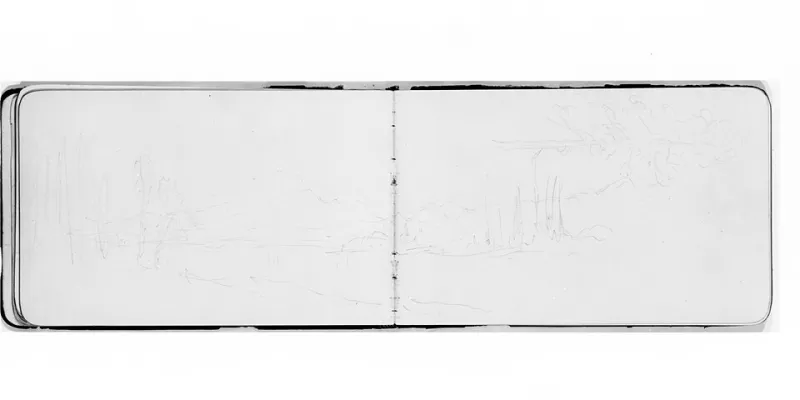
Photo: Albert Bierstadt, CC0, via Wikimedia Commons
There's a particular sound a sketchbook makes when it's been in a bag too long. A soft cardboard slump, a rustle of loose bits, the click of a pencil rolling free somewhere near the bottom. If you've ever sat next to an artist in a Colchester café and wondered what they were actually doing, this is the answer: not sketching a masterpiece, just keeping the engine running.
We asked three artists working in and around town to tip out their bags. What came out was not a portfolio. It was closer to a compost heap — and every one of them said the same thing: the good work starts here, in pages nobody is meant to see.
"It's not a portfolio, it's a compost heap"
Ruth Ellery paints mostly in oils and shows maybe twice a year, but her daily habit is a cheap A6 notebook that lives in her coat pocket. Flicking through it, you find the same bus shelter drawn eleven times, a coffee ring used deliberately as a horizon, and the word NO written across an entire page in biro.
"People think a sketchbook is a record of ideas," she says. "Mine's more of a bin that I keep. Everything goes in, most of it rots down, and once in a while something grows out of it."
The eleven bus shelters matter more than they look. Two of them became a larger painting of the Hythe at dusk; the rest exist purely so her hand remembers what a straight edge feels like. That's the quiet argument for drawing regularly — not output, just calibration.
The bag tells you as much as the book
Denny Okafor, who draws in pencil and gouache and teaches a bit at a studio off North Hill, carries a canvas pencil roll that's held together with a hair bobble. Inside: three 2B pencils worn to stubs, one very good pencil he refuses to sharpen, a putty rubber, a water brush and a small tin of pans that has been dropped so often the colours have migrated into each other.
"The good pencil is for the last five minutes," he says. "The stubs do the thinking."
Also in the bag: a folded envelope of scrap paper, a supermarket receipt he drew on in a queue, and a plastic wallet of things he's picked up — a ticket stub, a leaf from Castle Park, a torn bit of wallpaper from a skip in the Dutch Quarter. None of it is precious. All of it feeds the same habit.
Half a castle is fine
The third sketchbook belongs to someone who asked to be described only as "a weekend painter who works in town" — a mid-sized, hardback book with an elastic strap, half filled with views of Colchester Castle from roughly the same bench.
Her rule is simple: leave drawings unfinished on purpose. "If I finish everything in the book, I start treating it like a portfolio and then I stop drawing badly, and if I stop drawing badly I stop learning anything." The half-castles, the faint outlines of Hollytrees and the smudged attempts at the Jumbo water tower are all evidence of a person practising in public, which is a quietly brave thing to do.
Why the messy pages matter
All three artists said versions of the same thing: the sketchbook is where you're allowed to be bad. It's also where you solve problems you didn't know you had. A composition that won't work on a big canvas often reveals itself when it's two inches wide and drawn badly in a Wetherspoons.
There's a practical side too. Sketchbooks are how a lot of local work actually gets made — a colour note taken outside Firstsite, a shape spotted in the Castle Park flowerbeds, a corner of St Botolph's that later turns up in an entirely different painting. The finished thing gets the frame. The book gets the credit, silently.
If you fancy starting one
You don't need much, and the artists were cheerfully blunt about it.
Buy cheap, buy a few. Ruth's advice: two or three thin softcover books rather than one beautiful hardback. "If it cost fifteen quid you'll be scared of it. If it cost three, you'll fill it."
Carry it, don't plan it. Denny's rule is that a sketchbook only counts if it's on you. Keep it in a coat pocket or the front of your bag, not in a drawer at home waiting for a special occasion.
Ten minutes beats two hours. Most of what's in these pages was drawn in short bursts — while waiting for a bus on Culver Street, before a film at the Arts Centre, over the last of a coffee.
Give yourself a silly brief. Draw the same thing five days running. Draw only the shadows. Draw everything you can see in ninety seconds without lifting the pencil. Constraints make the blank page less terrifying.
Date the pages. Not for posterity — so you can see progress when you're convinced there isn't any.
Allow for wreckage. Glue things in. Cross things out. Write down the sentence someone said at the next table. Nobody is marking it.
A gentle nudge
The best time to start drawing in Colchester is probably a cold, bright morning in November, because the light on the castle is doing something worth looking at and there are plenty of warm places to thaw out afterwards. Take a cheap book, a pencil that's already blunt, and no expectations whatsoever. The pages don't have to be good. They just have to be yours, and they have to be started.
If you do begin one, keep at it until the elastic goes slack and the corners go soft. That's when it starts working.