The Rescue Bench: How Colchester’s Conservators Decide What Gets a Second Life
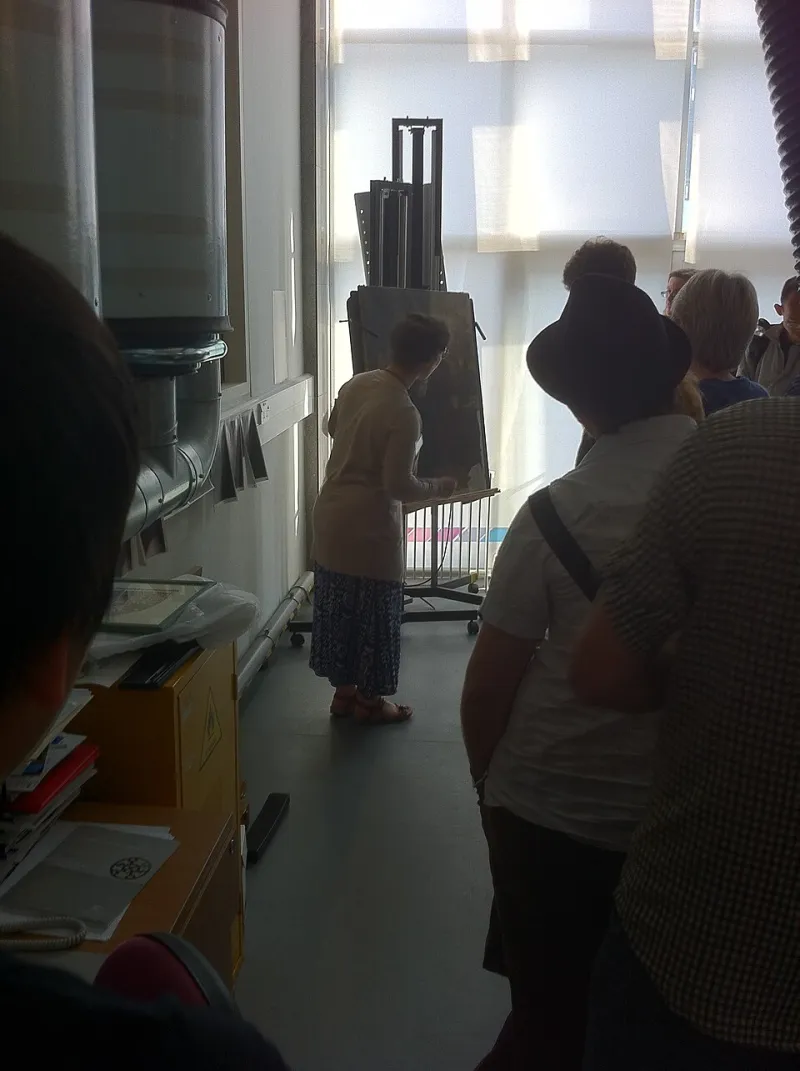
Photo: mooncow, CC BY-SA 3.0, via Wikimedia Commons
There is a particular smell in a conservation studio. Not the sharp tang of a hardware shop, and not the dusty sweetness of an attic either. It is something in between: size, solvent, old paper, clean cotton. On a grey November morning in Colchester, that smell is doing more work than any before-and-after photograph could. It is the smell of things being given time.
Most of us meet damaged art at the worst possible moment. A canvas slips off its hook. A print comes out of a damp box with a tide mark across the sky. A family portrait, passed down without instructions, turns the colour of weak tea. The instinct is either to panic or to reach for the nearest roll of tape. The conservators I spoke to in and around Colchester have a third response: stop, look, and ask what the object actually needs.
The bench is not a hospital
“People sometimes arrive expecting a miracle,” says Ruth, a paintings conservator who works from a small studio in the Dutch Quarter. “What they actually need is a plan.” Her bench is a calm landscape of swabs, brushes, tissue and tiny weights. A painting waits face-up under a soft light. It has a tear near one corner, the kind that looks catastrophic to an owner and fairly ordinary to a conservator.
The first job is not repair. It is diagnosis. Is the tear old or new? Is the canvas brittle? Has someone already tried to fix it with glue? Has the paint layer started to lift? Ruth explains that a conservator is not a restorer in the make-it-look-new sense. The aim is stability, legibility and honesty. You want the work to survive, not to pretend it was painted last week.
That distinction matters more than most of us realise. A painting with a visible repair can still be a healthy painting. A painting that has been over-cleaned, over-painted and flattened into submission may look brighter in a photograph and be much worse off in fifty years.
Three benches, three kinds of damage
A short walk from Firstsite, a paper conservator called Sam works with prints, drawings and watercolours. His current patient is a water-damaged etching found in a Lexden loft. The paper has cockled, the ink is stable but the margins carry the brownish bloom collectors call foxing. Sam is unfailingly polite about the previous rescue attempt — a strip of household tape, now yellow and brittle.
“Tape is the enemy,” he says, with the weariness of someone who has said it many times. “Not because people are careless. Because they are trying to help.” He will remove the tape mechanically, humidify the paper slowly, reduce the staining where it is safe to do so, and accept that some marks will remain. That acceptance is part of the ethics. Paper remembers.
Over in Wivenhoe, another conservator, Ellen, deals with frames, small objects and the awkward relatives of the art world: family photographs, textiles, and the odd sentimental object that is not quite a painting but not quite anything else. She talks about “the hierarchy of intervention” — doing the least necessary thing first, and documenting everything. A loose hinge might need a repair. A faded inscription might need nothing at all.
What all three have in common is a refusal to rush. A tear can take days. A varnish clean can take weeks. A decision about whether to fill a loss in a portrait’s background can take longer than either, because it involves a conversation about what the owner wants and what the object can tolerate.
The ethics of not making it new
Conservation has a vocabulary that sounds almost philosophical: reversibility, minimal intervention, original material, condition reporting. In practice, these words are practical guardrails. If a treatment can be undone, a future conservator is not stuck with today’s choices. If you use as much original material as possible, you keep the object’s history intact. If you document every step, you leave a paper trail for the next pair of hands.
The hardest choices often involve faces. A family portrait with a faded varnish may look muddy, but cleaning can reveal a colder palette underneath. A previous restorer may have repainted an eye or a collar; removing that paint could expose the original but also leave a visible scar. There is no single right answer. There is only a well-argued one, agreed with the owner and recorded on file.
This is why the best conservators are good listeners. They are not selling a fantasy of perfection. They are helping you decide what you value: the likeness, the age, the maker’s hand, the family story, or simply the fact that it survived.
Is it worth saving?
Not every object justifies the cost of treatment, and conservators are refreshingly honest about that. A mass-produced poster with a torn corner may not merit a full paper treatment. A modest watercolour with a family inscription might. The calculation is rarely just financial.
A few practical rules apply to almost everything. Do not tape, glue or trim anything. Keep works off damp walls and out of lofts, garages and direct sun. If a piece is mouldy, isolate it and get advice before you touch it. Photograph the damage. Ask for a condition report and a written estimate. Check whether the person you are speaking to is accredited — in the UK, the Institute of Conservation (Icon) is the professional body to look for. And if a quote feels enormous, ask what the treatment actually involves. Sometimes the honest answer is that a simpler stabilisation will do.
Ruth puts it neatly: “We are not here to erase history. We are here to make sure the object has a future.”
That future might be a wall in a Colchester living room, a local archive, or a gallery store. It might be a portrait that stays in the family for another generation, brown varnish and all. The rescue bench is not a place where damage disappears. It is a place where damage is understood, contained and, very often, forgiven.
If you have something that almost didn’t make it, the first step is not a repair. It is a conversation. In a town with as many old buildings, inherited pictures and charity-shop finds as Colchester, that seems like a useful thing to remember.