The Jam Jar, the Dentist’s Mirror and the Brick: What Colchester Artists Actually Reach For
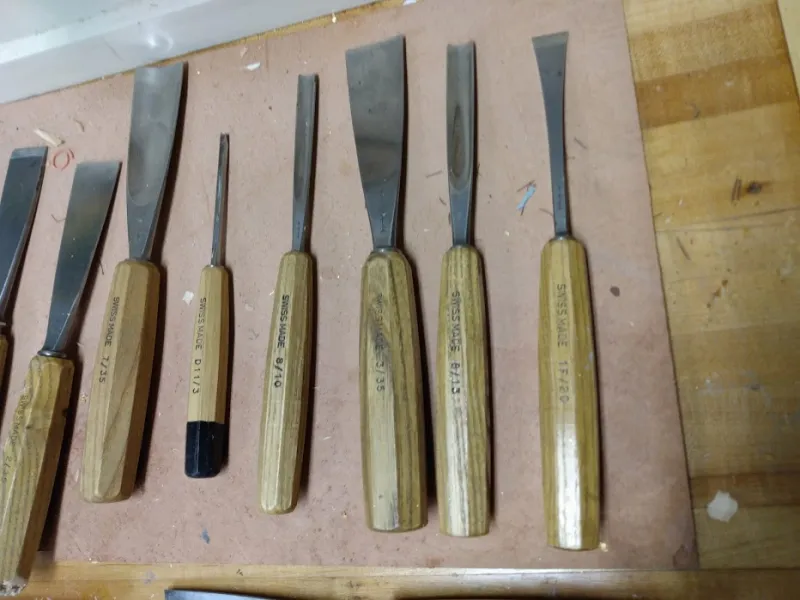
Photo: David Adam Kess, CC BY-SA 4.0, via Wikimedia Commons
Walk into most art supply shops and you’ll be sold a fantasy: pristine brushes, matching aprons, a palette that has never seen a muddy grey. Walk into a working studio in Colchester and you’ll find something closer to a shed, a kitchen and a car boot sale holding hands.
That’s not a criticism. It’s the point.
We asked six artists around town a simple question: what is the oddest, oldest or least likely object you couldn’t work without? Nobody mentioned a sable brush. What came back was a jam jar, a dentist’s mirror, a brick, a credit card, a homemade sanding block and a palette knife with someone else’s initials scratched into the handle. Each one opens a small door onto how art is really made here — not in a catalogue, but on a bench, with the heating on and the radio slightly too loud.
The palette knife that still smells of somebody else’s studio
Marion Ellery paints in a studio at Cuckoo Farm, and the tool she reaches for most is a blunt, slightly bent palette knife she inherited from a neighbour’s aunt. It has the initials M.F. scratched into the handle. Marion doesn’t know who M.F. was.
‘I’ve bought new ones,’ she says. ‘They’re too stiff. This one has been worn into my hand. It’s got a bend in it that I’ve learned to work with.’ She uses it for mixing, scraping back, and lifting paint in thin, dragged lines that have become part of her language. When the handle cracked two winters ago, she fixed it with epoxy rather than replace it. ‘The knife decides the painting as much as I do,’ she says. That sounds romantic until you see the blade: chipped, darkened, absolutely specific. It is not a tool you could order online.
A sanding block cut from a skirting board
Tom Beckwith makes furniture and small sculptures from a garage in Lexden. His essential object is a sanding block he cut from an offcut of skirting board eleven years ago. It is a rectangle of pine, worn into a shallow curve where his thumb sits.
‘You can buy a cork block for four quid,’ he says. ‘I’ve had this for eleven years. The weight is right.’ He wraps it in whatever abrasive paper is closest, usually from a local builders’ merchant, and uses it to finish ash and oak. The block has been dropped, sat on, and once used as a doorstop. He says he would be lost without it, then laughs at himself. ‘It’s a piece of wood. But it’s the piece of wood that knows my hand.’
The dentist’s mirror from a car boot sale
Priya Shah is a printmaker working from a spare room in Wivenhoe. Her odd tool is a dentist’s mirror bought at a Colchester car boot sale for £2. She uses it to inspect etching plates under raking light.
‘A scratch you can’t see straight on will jump out in the mirror,’ she says. ‘It’s saved me from ruining a plate more times than I can count.’ The mirror is attached to a thin metal handle that has been taped up with electrical tape. Priya says proper inspection mirrors exist, but she likes the angle of this one. It lives in a mug beside her etching needle. ‘It’s not a precious object. It’s just the right object.’
The brick wrapped in a tea towel
Sara Okonjo makes ceramics near The Hythe. Her essential tool is a brick from her garden, chipped at one corner and wrapped in a faded tea towel. She uses it as a weight when joining slabs of clay.
‘It’s the exact weight of a small dog,’ she says. She could buy proper weights. She has tried. ‘They’re too neat. This one has a history. It was the last brick from a wall my dad took down.’ The tea towel stops it marking the clay. When the brick eventually breaks, she says she’ll find another one. ‘But I’ll miss this one. It’s got a good flat side.’
The expired credit card that spreads ink
Ben Archer is an illustrator and occasional screenprinter. His odd tool is an expired credit card, cut into different widths with scissors. He uses it as a squeegee for small two-colour A4 prints.
‘It’s got the right flex,’ he says. ‘A proper squeegee is better for big runs, but for a small print it’s perfect.’ The card expired years ago; he keeps it because the edge is still sharp enough to pull ink across a screen. When it gets ragged, he trims it with scissors and carries on. ‘It costs nothing. It works. Why would I replace it?’
The jam jar with no lid
Ruth Callis is a textile artist in New Town. Her object is a Bonne Maman jam jar with no lid and a chip on the rim. She uses it for mixing dye and holding dirty water.
‘The glass is thick, and the chip lets me pour a thin line,’ she says. She has bought proper water pots. ‘They tip over.’ The jar has survived three house moves and one studio flood. It is, she says, the only thing in her workspace that has never been knocked off the table. ‘It’s not special. That’s why it’s special.’
What the odd tools tell us
These aren’t quirks for the sake of it. They are a local philosophy in object form: repair rather than replace, use what is already here, and trust the thing that has been worn into your hand. Colchester’s creative scene is full of people making do in the best sense — not because they have to, but because the making-do often produces better work.
So if you visit an open studio this winter, or wander into Firstsite or a smaller artist-led space, don’t just look at the work. Ask what’s on the bench. The answer will tell you more than any artist statement. It will tell you about the brick, the jam jar, the borrowed knife — and the town that shaped the hands using them.