The Morning After the Private View: Inside a Colchester Gallery’s Deinstall Day
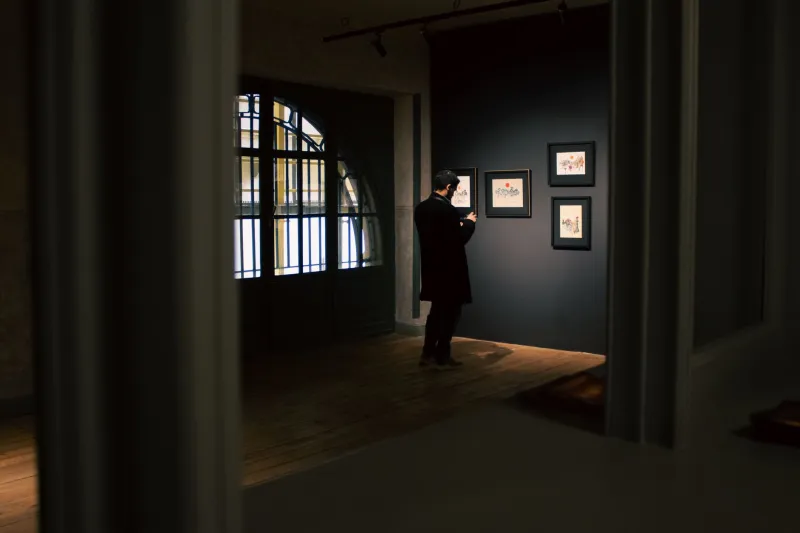
On a grey November morning in 2026, a small gallery near Colchester’s Castle Park looks like a room after a party. There are chairs stacked by the door, a bin bag full of plastic cups, and a faint smell of coffee. The private view was last night. Everyone said lovely things about the show. By 8.45am, the same room is being taken apart with the care of a museum store.
Deinstall day is the part of exhibition-making that audiences almost never see. It is also the part that tells you the most about how much care goes into a local show. Taking work down is not the opposite of putting it up. It is the same job in reverse, with more paperwork and fewer people around to admire it.
The checklist before the first screwdriver
Before anything moves, there is a conversation. The curator, the technician and whoever is handling the loans stand in front of the wall and go through a list. Which works are going back to the artist? Which are on loan from a private collection? Which are being stored on site? Is there a courier coming, and what time? Has every condition report been signed?
A condition report is exactly what it sounds like: a written and photographic record of how a work looked when it arrived. It notes scratches, frame chips, loose canvas corners, old repairs and anything else that could be blamed on the gallery later. On deinstall, that report comes out again. The work is checked against it, ideally in the same light, before it is wrapped. If something has changed, it is photographed and noted. No one is trying to catch anyone out. The point is to make sure the art leaves in the same state it arrived.
Taking work down without taking chances
Then the gloves come on. Not always white cotton gloves — some works are handled with nitrile gloves, some with bare hands if the surface is stable and clean — but always with a plan. Two people lift a framed piece, one at each side. No one carries a painting by the frame alone. No one puts a corner down on a hard floor. No one touches the face of a canvas, even with clean hands.
The small things matter more than you would think. Glass is taped with low-tack tape before a frame is moved, just in case. Bubble wrap goes on the outside, never directly against a fragile surface. Acid-free tissue protects areas that might rub. Works on paper go into solander boxes or portfolios. Sculptures are padded, bagged and moved in crates if they have them. If a piece is heavy, it is not heroic to ask for a second pair of hands. It is the whole job.
There is also the quiet business of documenting the show. Before the walls are empty, someone takes installation photographs: each wall, each corner, each work in relation to the others. These images go into the gallery’s records and often into the artist’s own archive. They are also what you see on social media later. A good install shot can make a small show look like it had a bigger budget than it did.
The paperwork that follows the art
Once the work is down, the paperwork starts. Loan forms are checked. Edition numbers are confirmed. Artists sign for returned pieces. If a work has been sold, the gallery checks the buyer’s details and arranges collection or shipping. If it has not sold, it goes back to the artist or into storage. None of this is glamorous. All of it is what makes the next show possible.
In Colchester, many of these shows are run by small teams, freelancers and volunteers. The same person who wrote the press release might be the one wrapping frames. The artist might be helping to carry their own work to the car. That is not a weakness. It is what local galleries do well: they stay close to the people making the work.
Crates, corners and climate
Storage is the unsung hero of the art world. A work that is taken down carefully can still be damaged by a damp corner, a hot radiator or a stack of frames leaning the wrong way. Paintings are usually stored vertically, face to face or back to back, with padding between them. Works on paper go flat in boxes. Textiles are rolled. Anything fragile gets its own corner and a label that says exactly what it is and when it was last checked.
Climate matters too. Rapid changes in temperature and humidity are bad for almost everything. A gallery store does not need to be a laboratory, but it does need to be stable and dry. Pest checks are part of the routine. So is insurance. So is the simple question of whether there is enough room for the next show without moving everything twice.
What the audience doesn’t see
The private view is the visible bit. The deinstall is the proof that the whole thing was real. It is also a reminder that an exhibition is not just a room full of objects. It is a chain of agreements, favours, forms and careful hands. The artist trusted the gallery with the work. The lender trusted the gallery with the loan. The audience trusted the gallery to show them something worth leaving the house for.
When the doors close, that trust does not switch off. It turns into a checklist. It turns into a roll of tape and a box of tissue. It turns into someone saying, see you at the next one.
How to support the next show
You do not need to work in a gallery to support this side of things. Start by visiting before the final week. Leaving it until the last hour makes deinstall harder and gives you less time with the work. If you love something, ask about it. Buying a piece, a print or a catalogue is the most direct way to help a small gallery keep going. Sharing a show online with credit costs nothing and reaches people the gallery might not know.
Sign up to the mailing list. Go to the artist talk. Volunteer if you have the time. And when you see a technician carrying a frame, hold the door. It sounds small. It is small. But deinstall day is made of small things, and so is the next exhibition.