Please Do Sit: The Unofficial Sculpture Trail Hiding in Colchester’s Street Furniture
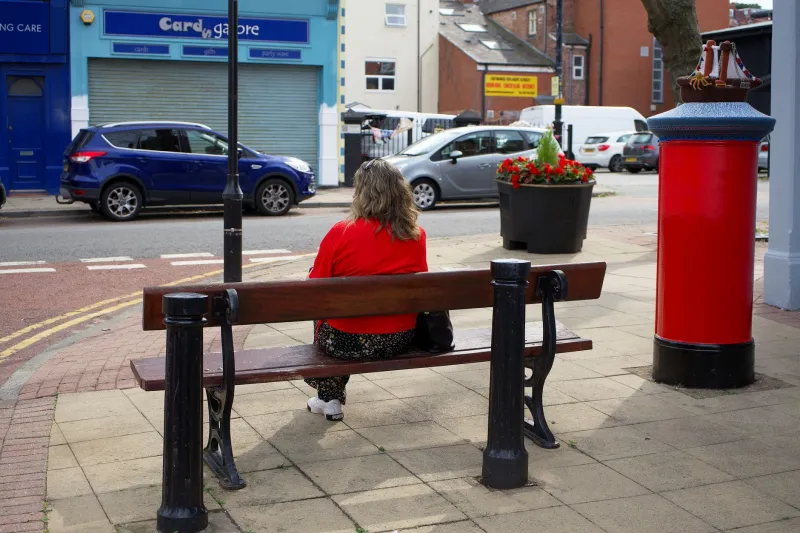
There is a particular kind of Colchester afternoon — grey sky, damp paving, the castle keep doing its usual heavy lifting on the skyline — when a gallery feels like too much effort and the town centre feels like exactly enough. This is a guide for that afternoon. Not to the paintings inside the rooms, but to the things you lean on, walk over and queue beside: the benches, bollards, railings, paving slabs and doorways that make up Colchester’s accidental public art collection.
None of it was made for a plinth. That is the point. Street furniture is designed to be useful, safe and forgettable. And yet, look closely, and the town is full of objects with a sculptural presence: a cast-iron bench end with more thought in it than some gallery labels, a row of bollards that reads like a minimalist installation, a doorway that frames the street like a picture.
Start where the town shows off
Begin at Castle Park, near the main gates. The castle is the obvious sculpture — a Norman keep sitting on the foundations of the Temple of Claudius, a lump of history that has been reused, ruined and rebuilt around for centuries. But the park is also a lesson in how Colchester displays itself. Benches face the keep. Paths curve to direct your eye. Railings hold the edge of the grass like a drawing frame.
A local furniture maker who repairs and rehomes benches around north Essex told me that people rarely notice a bench until it is gone. “A good bench has a bit of weight to it,” she said. “You can feel when the proportions are right. The armrest sits where your arm actually wants to go. The back has a slight lean. It is not decoration, but it is design, and design is half a sculpture already.”
Sit on a few. Not for long — it is November, and the metal will find your bones — but long enough to notice how the seat changes your view. A bench that faces the castle makes you a spectator. A bench tucked under a tree makes you a lurker. Same town, different script.
The bollards are having a moment
Walk from the park towards the High Street and you will meet Colchester’s least appreciated sculptural form: the bollard. Some are plain, some have a little collar or dome, some are weathered to a soft charcoal. Arranged in a row, they do what a line of plinths does in a gallery — they create rhythm. They say: this is a place for people, not cars. They also cast excellent shadows when the low winter sun finally shows up.
A graphic designer who lives off Maldon Road told me she started photographing bollards during lockdown walks and has never quite stopped. “It sounds ridiculous until you see a row of them at dusk,” she said. “They are like a repeated mark in a drawing. The eye wants to count them. The town is full of these little visual rhymes, and most of us walk straight past.”
Paving, railings and the art of the useful edge
The High Street and the lanes around Trinity Street are a masterclass in accidental pattern. Paving slabs change colour and size. Old kerbs meet new tarmac. Railings divide a churchyard from a pavement with a line of black verticals that would not look out of place in a print show. Doorways in the Dutch Quarter frame brick, glass and shadow in a way that makes you want to stand still and look, even if you are technically just waiting for a bus.
This is where the walking-list format helps. Give yourself a rule: follow one material for ten minutes. Follow iron. Follow stone. Follow the painted lines on the road. You will start to see the town as a series of decisions — some grand, some municipal, all visible.
What makes a bench feel like a sculpture?
It is not just age or ornament. It is placement, proportion and use. A bench with a good view is a stage set. A bench with a worn armrest is a record of hundreds of small conversations. A bench that has been repaired — a new slat, a bolted bracket, a patch of different wood — carries its own history in the way a bronze carries a patina.
The same goes for doorways. A deep recess makes a threshold feel theatrical. A fanlight above a door turns an ordinary entrance into a frame. A handle worn smooth by hands is a small piece of participatory art, made by everyone who has ever pushed it.
A short town-centre wander
Start at Castle Park gates. Walk towards the High Street, then loop through Trinity Street and down towards Culver Street. Cut through Lion Walk, cross towards the Dutch Quarter, and finish near the Mercury Theatre or Firstsite if you want an indoor coda. The route is not long — maybe forty minutes at a stroll — but it is dense with things to notice.
Do not try to see everything. Pick three prompts and stick to them:
- Find a bench with a repair. What does the repair tell you?
- Follow a line of bollards and notice how the spacing changes.
- Look at three doorways. Which one frames the street best?
- Trace a railing’s shadow. Where does it land?
- Find a paving slab that does not match its neighbours. Why is it there?
The town as a collection
Colchester does not need a new sculpture park to have public art. It already has one, spread out and half-hidden, made of things we are meant to use rather than admire. The trick is to treat the street as a collection with no wall labels. The bench is the sculpture. The bollard is the sculpture. The doorway is the frame.
So next time you are in town with twenty minutes to spare, do not head straight for a gallery. Sit down. Look up. Count the bollards. The exhibition is already open, and the admission is free.